Goalie Pad Strapping Guide: How Each Strap Affects Fit and Rotation


Every goalie has tightened every strap as hard as possible at least once. Most found out quickly that it did not help. The pads fought back, the butterfly felt slow, and the knees ached by the second period.
This goalie pad strapping guide is not about tightening everything down. It's about understanding what each strap actually does — so you can tune your setup for clean rotation, stable knee landing, comfortable ankle movement, and a feel that's repeatable every time you drop, slide, and recover.
Whether you're suiting up for the first time or you've been in the crease for 20 years, the right strapping setup starts with understanding the system — not just copying what you saw on a YouTube video.
Quick Answer
Goalie pad straps should be secure, not strangled. The knee strap is one of the biggest factors influencing landing stability and pad rotation, but it works together with the knee cradle, leg channel, calf straps, and pad design. Your calf straps control how the pad moves around your leg. Your boot strap and toe ties control ankle mobility and pad return. Start with correct pad sizing, confirm your knee lands on the stack, then adjust one strap at a time. Test everything while actually moving — not just standing in the locker room.
How Tight Should Goalie Pad Straps Be?
The short answer: tight enough to control the pad, loose enough to let it move.
Proper strapping is necessary to ensure the pads are not too tight on the goaltender's legs. A good setup keeps the pad controlled and the knee stable on the landing block—but it doesn't lock the pad to your leg like a cast.
Follow these basic setup rules before you start fine-tuning:
- Start with the correct pad size.
- Confirm your knee lands on the knee stack.
- Keep the knee area stable, but not locked down.
- Adjust calf straps to balance control and rotation.
- Use toe ties that allow enough ankle movement.
- Avoid overtightening the boot or heel strap.
- Always test the setup while moving, not just standing still.
| Setup Goal | What It Should Feel Like |
|---|---|
| Knee Landing | Stable on the knee stack without sliding off. |
| Pad Rotation | Rotates smoothly into the butterfly without resistance. |
| Calf Control | Connected to the leg without feeling overly restrictive. |
| Ankle Movement | Enough freedom for natural recoveries and lateral movement. |
| Pad Return | Returns to position smoothly without twisting or lagging. |
| Overall Feel | Secure, comfortable, and consistent throughout every save. |
Fit Check First: Straps Cannot Fix the Wrong Pad Size
Before you touch a single strap, make sure the pads actually fit.
Each pad is structured with sections like the thigh rise, goalie knee stacks, boot, and calf wrap. The knee cradle, which holds the knee in place, plays a critical role in overall pad performance. If your knee doesn't land correctly on that knee stack, strapping is not the fix — sizing is.
A pad that's too large may feel manageable if you tighten everything, but you're just compensating for a core fit problem. A pad that's too small will feel mobile, but loosening the straps won't create proper coverage.
Fit First Rule: If your knee doesn't land on the stack, strap tension is not the solution. Check pad size, knee cradle, and full-gear fit before adjusting anything.
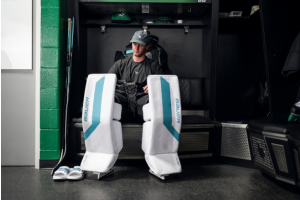
Before adjusting your straps, put on everything you actually wear on the ice:
- Goalie skates
- Goalie pants or breezers
- Knee guards
- Goalie socks and any underlayers
Then run a quick fit check. Drop into the butterfly. Check where your knee lands. Confirm the pad face rotates square. Recover and see whether the pad returns naturally. If the pad only feels usable when every strap is cranked tight, the issue is likely size, leg channel depth, or pad style — not tension.
> Need help sizing? Check out the GoalieMonkey Goalie Leg Pad sizing guide for size charts, ATK measurement help, and brand-specific fit notes.
How Goalie Pad Rotation Works
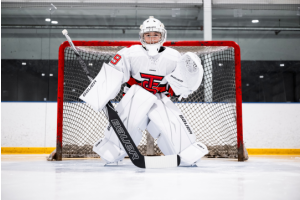
Hockey goaltenders who use the butterfly style require their pads to rotate forward as they drop to their knees, so the pads continue to face the shooter and puck. Most modern flat-front or box-style butterfly pads are designed to assist in the rotation process.
When a goalie goes down into the butterfly position, it's desirable for the pad to rotate forward slightly around the goalie's shin until it lands flush to the ice. This creates a nice landing pad for the goalie's knee, seals the pad to the ice and ensures that the toe is also square and flush to the ice surface.
When a goalie gets back up to their feet, the pads should come back to being square to the goalie's leg. If you're pushing the pads back into position with your hands after a save, that's a rotation problem worth fixing.
Two failure modes to understand:
- Over-rotation: Over rotation is when the goalie pad twists too far in relation to the ice surface. This can sometimes cause the pad to get "stuck" in this position and not return to center on its own. Occasionally this will cause a goalie's knee to fall off the knee block and hit the ice.
- Under-rotation: Under rotation is when a goalie's pads do not rotate enough in relation to the ice surface to get that perfect seal along the ice. This can cause poor 5-hole coverage as well as gaps between the pad and the ice near the boot break.
The goal is balance. Pad rotation depends on your knee strap, calf straps, boot strap, toe ties, leg channel, knee cradle, and knee guards all working together. Too much restriction = no rotation. Too little control = sloppy, delayed, or over-rotated pads.
Strap-by-Strap Overview: What Each Part Does
Each connection point on the pad affects a specific area of fit and movement. Understanding the job of each strap makes it much easier to diagnose problems and fix them one area at a time.
| Strap or Area | Main Job | What It Affects |
|---|---|---|
| Knee Strap | Controls knee connection and landing feel. | Knee stability, pad rotation, and overall comfort. |
| Upper Calf Strap | Secures the upper portion of the lower leg. | Pad rotation, calf connection, and response speed. |
| Lower Calf Strap | Controls the lower pad and boot area. | Recovery speed, lower-leg control, and boot stability. |
| Boot / Heel Strap | Anchors the pad near the skate. | Ankle mobility, pad feel, and recovery. |
| Toe Ties | Connect the pad boot to the skate. | Pad rotation, ankle mobility, and pad return. |
| Leg Channel | Determines how the leg sits inside the pad. | Overall connection, rotation, and comfort. |
| Knee Cradle | Supports the knee while allowing controlled movement. | Knee mobility, pad rotation, and knee guard compatibility. |
Once you understand what each part does, adjusting your pads becomes a system—not guesswork.
Knee Strap: Behind the Knee, Down to the Calf, or Removed
The knee strap is the single most impactful setup point on a modern goalie pad. Where and how you run it changes everything from rotation speed to how stable the pad feels when your knee hits the stack.
As the butterfly technique came into prominence, goalies started wanting their pads to rotate in order to present as much of the pad face as possible even when on their knees. In order to get the desired rotation, goalies started to wear their pads more loosely and began removing straps from the outer lateral section of the pad. The thinking behind the removal/repositioning of the straps is the fact that they come into contact with the leg as the knee attempts to rotate in the pad, thereby slowing down the overall pad drop velocity. The less contact with the leg, the less restriction when dropping.
Knee Strap Behind the Knee
Running the knee strap behind the knee creates the most direct connection. It can feel secure and is often the right starting point for newer goalies who want the pad to feel attached and controlled. The downside: if it's too snug, it can restrict rotation noticeably. If your butterfly feels sticky or the pad doesn't turn cleanly, the behind-knee setup may be too tight.
Works well for:
- Beginners who want a secure, locked-in feel
- Goalies whose knees feel unstable without direct connection
- Hybrid and stand-up goalies who drop less frequently
Knee Strap Down to the Calf
Over the past 5 years, more and more goalies have been dropping their knee cradle elastic down toward the calf. Running the strap down to the calf opens the knee area and allows the pad to rotate much more freely — which is exactly what butterfly goalies need.
Works well for:
- Butterfly goalies who want faster, cleaner rotation
- Goalies who wear separate knee guards that feel crowded behind the knee
- Goalies who want more freedom through the drop
The trade-off: the knee area feels more open. If your knee starts drifting off the stack, dial in the strap tension or check your knee cradle fit before going looser.
Knee Strap Removed
Some goalies remove the knee strap entirely when the pad design allows it. Dropping the elastic toward the calf has been shown by Ryan Frayne PhD to increase the velocity goalies can bring their pads to the ice, and that research has been used to inform the designs on CCM's pads. Removing the strap entirely takes that concept to its furthest point.
This works best for experienced butterfly goalies with strong calf control and a stable knee cradle. It's not the right call if your knee slides off the stack or the pad feels loose during recovery.
Calf Straps: Control, Rotation, and Lower-Leg Feel
The strapping system on a leg pad can affect the entire fit, feel, and performance of your goalie pads. Nowhere is that more true than the calf.
Calf straps are your primary control point for how the pad moves around your leg. They're the balance point between "the pad feels connected" and "the pad rotates freely."
| Calf Strap Setup | What You'll Notice |
|---|---|
| Too Tight | Pad resists rotation, feels restrictive, and may slow butterfly movement. |
| Too Loose | Pad feels delayed or disconnected and may rotate inconsistently during recoveries. |
| Balanced | Pad stays connected to the leg while rotating freely into and out of the butterfly. |
Upper Calf Strap
The upper calf strap sits closest to the knee area and has the biggest influence on pad rotation. Keeping this strap moderately snug helps the pad respond quickly without restricting movement. If your butterfly feels slow or the pad hangs on your leg before rotating, this is often the first strap worth loosening slightly.
Lower Calf Strap
The lower calf strap controls the bottom portion of the leg pad above the boot. It helps stabilize the lower leg during slides, recoveries, and post integrations. Tightening it too much can reduce rotation near the skate, while leaving it too loose can make the pad feel unstable during lateral movement.
The Professor Strap: What It Is and When to Use It
If you've spent any time in goalie gear forums, you've seen the term. Here's the real story.
The Professor Strap features a hidden leather strap at the very top of the calf, at the very bottom of the knee, that is cinched down very tightly, and that strap actually runs through the foam of the pad's interior. This allows goalies to wear their pads very loose but keep the knee from slipping off the knee block — which is critical when wearing very large knee guards.
The concept is elegant: instead of relying on a behind-knee strap that fights rotation, you put firm tension at the very top of the calf — just below where the knee cradle ends. The strap sits below the bulkiest part of your knee guards, which typically sit directly in front of the knee when the goalie is standing, whereas this strap attaches where the knee joint ends and calf begins.
The result: The rest of the pad can be strapped loosely for free rotation, but the knee stays locked on the stack.
The key is to put the main tension point of the pad at the top of the calf. This can be done by angling and tightening the calf elastic downward and/or placing a strap with decent tension at that point — a "Professor Strap."
Not every pad comes with this strap built in, but many goalies replicate the concept by using a tight upper calf strap positioned as low as possible below the knee cradle. If your knee keeps drifting off the stack with a loose setup, this is worth trying before adding strap tension everywhere else.
Boot or Heel Strap: Anchored Feel vs. Ankle Freedom
A major trend over the past several years has been goalies changing how they use—or whether they use—their boot straps at all. While the traditional under-skate boot strap was once nearly universal, many modern goalies now prefer running the strap behind the heel or removing it entirely to maximize pad rotation and mobility.
There isn't one "correct" setup. Each option changes how the pad sits on your leg, rotates into the butterfly, and recovers back to your stance.
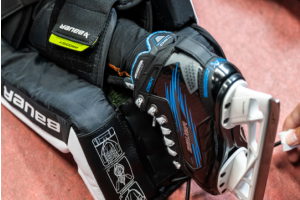
The Traditional Under-Skate Boot Strap
Running the boot strap underneath the skate creates the most connected feel between your skate and the pad. It limits independent movement of the boot and keeps the pad anchored throughout your stance and recoveries.
This setup is often preferred by newer goalies, hybrid-style goaltenders, or anyone looking for maximum stability and a predictable feel.
The "Lundy" Heel Loop Setup
Popularized by Henrik Lundqvist, the "Lundy Loop" routes the boot strap through the heel loop on the back of the skate instead of underneath the blade. This raises the pad slightly, improves ankle mobility, and encourages quicker pad rotation without completely disconnecting the boot.
Its popularity has grown so much that nearly every modern goalie skate now includes a dedicated heel loop specifically for this setup.
No Boot Strap
Some butterfly goalies choose to eliminate the boot strap entirely. Without it, the pad can travel farther up the leg when dropping into the butterfly, helping improve five-hole closure and allowing maximum pad rotation.
However, removing the boot strap also means the calf straps and toe ties become much more important. If they're not adjusted properly, the pad can rotate too far or feel unstable during recoveries.
| Boot Strap Setup | Best For | Primary Benefit |
|---|---|---|
| Under-Skate (Traditional) | Beginners, hybrid goalies, stability-focused players | Maximum skate-to-pad connection and consistent control. |
| Lundy Heel Loop | Modern butterfly and athletic goalies | Better ankle mobility, improved pad rotation, and a slightly higher pad position. |
| No Boot Strap | Experienced butterfly goalies with dialed-in strapping | Maximum pad rotation, mobility, and five-hole closure. |
Toe Ties: Lace, Bungee, Hybrid, and Offset Systems
Toe ties play a major role in how your goalie pads rotate into the butterfly and how quickly they return to position when you recover. While they're a relatively small part of the pad, changing your toe tie setup can dramatically alter mobility, responsiveness, and overall feel.
Traditional Lace Toe Ties
Traditional skate lace toe ties create a direct connection between the skate and the pad. The challenge is finding the right amount of slack. Too tight and ankle movement becomes restricted. Too loose and the pad may not return to position consistently after recovering from the butterfly.
Many goalies still prefer lace toe ties because they provide a connected, predictable feel and simple adjustability.
Elastic (Bungee) Toe Ties
Elastic toe ties have become the modern standard across nearly every major goalie brand. Their stretch allows the ankle to move naturally while maintaining enough tension to help the pad rotate back into position after a save.
For many goalies, bungee systems improve comfort, reduce stress on the ankles and knees, and make recoveries feel smoother without sacrificing responsiveness.
Hybrid Toe Ties
Hybrid systems combine traditional lace characteristics with elastic components. They provide more structure than a full bungee setup while still allowing additional ankle mobility compared to pure skate laces.
They're an excellent option for goalies transitioning from traditional laces who aren't ready to switch completely to elastic toe ties.
Fixed, Sliding, and Offset Toe Bridges
The toe bridge on the pad also changes how the connection behaves.
- Fixed Bridge: Keeps the connection centered and consistent.
- Sliding Bridge: Allows the attachment point to move with the skate, promoting easier rotation.
- Offset Bridge: Positions the connection toward the inside edge of the pad, which some goalies prefer for butterfly seal and post integration.
The goal isn't maximum tension—it's balanced tension. A toe tie that's too tight can limit rotation and ankle mobility, while one that's too loose can delay pad recovery and create an unstable feel.
| Issue You're Feeling | What to Check | Possible Adjustment |
|---|---|---|
| Ankle feels restricted | Toe tie tension | Add more slack or switch to an elastic system. |
| Pad doesn't rotate back after butterfly | Toe tie length and boot strap setup | Reduce slack slightly or re-balance the lower pad strapping. |
| Boot feels loose or disconnected | Tie length and toe bridge location | Shorten the connection or experiment with a different bridge style. |
| Post pushes feel awkward | Bridge style and toe tie system | Test a sliding or offset bridge if your pads offer the option. |
Leg Channel and Knee Cradle: Why Strap Tension Feels Different by Pad
Two goalies can use identical strap tension and get completely different results. That's because the leg channel and knee cradle change how everything behaves.
The knee cradle, which holds the knee in place, plays a critical role in overall pad performance. Features like adjustable straps and leg channel adjustment systems help personalize the fit.
The leg channel is the space your lower leg sits inside. A tight leg channel creates a more direct connection — the pad responds immediately when your leg moves. A looser leg channel allows the pad to rotate more independently around your shin. Newer box-style pads rotate easily and sit more in front of the shin and rotate around the leg, versus bending with it.
The knee cradle controls how much freedom your knee has at the top of the pad. An open cradle allows more rotation and is better for butterfly goalies with separate knee guards. A more locked-in cradle feels secure but can restrict movement if the strap setup is also tight.
This is exactly why copying another goalie's strapping setup doesn't always work. Their pads, knee guards, leg shape, stance, and preferences may be completely different from yours.
Knee Guards and Full-Gear Fit
Slimmer knee pads restrict pad rotation less. Bulkier external knee guards can crowd the knee cradle and push the knee off the landing area if the strap path isn't adjusted to accommodate them.
Always strap your pads while wearing the knee guards you actually use. A setup that feels perfect without knee guards can feel completely different — and fail — with them on.
Knee guards affect:
- Where your knee lands on the stack
- How the knee strap feels behind vs. down to the calf
- Whether the knee catches or binds during rotation
- Whether the pad returns cleanly after recovery
If your knee guard keeps catching, try moving the knee strap down to the calf to create more room in the knee area. If the knee still slides off the stack, check the knee cradle width and your guard's profile before assuming the pad itself is the problem.
Recommended Strapping Setup by Goalie Type
No two goalies strap their pads exactly the same. Your playing style, flexibility, experience, and equipment all influence what feels best. Use the recommendations below as a starting point, then make small adjustments based on how your pads rotate, recover, and feel on the ice.
| Goalie Type | Recommended Strapping Focus | Common Mistake to Avoid |
|---|---|---|
| First-Time or Youth Goalie | Prioritize knee stability, comfort, and a simple, repeatable setup. | Overtightening every strap in an attempt to make the pads feel more secure. |
| Growing Youth Goalie | Focus on proper knee landing, mobility, and consistent recovery while leaving room for growth. | Using strap tension to compensate for goalie pads that are too large. |
| Butterfly Goalie | Encourage clean pad rotation with flexible toe ties, balanced calf straps, and minimal restriction around the boot. | Calf or boot straps that are too tight and prevent smooth butterfly rotation. |
| Hybrid or Reactive Goalie | Maintain a connected feel while allowing enough ankle mobility for dynamic movement. | Leaving the pads so loose that recoveries feel delayed or inconsistent. |
| Beer League Goalie | Choose comfort, consistency, and a setup that's quick to adjust before games. | Constantly changing strap settings instead of building consistency. |
| Competitive or Elite Goalie | Fine-tune rotation, landing stability, and recovery speed with small strap adjustments. | Ignoring minor strap changes that can noticeably affect performance. |
For youth goalies especially, remember that youth pads differ from senior models in more than just size—they're designed to be lighter, more flexible, and easier to move in. If your child's knee isn't landing properly on the knee block, the solution is almost never tighter straps. Start with correctly sized goalie pads, then use the strapping system to fine-tune the fit.
Brand-Specific Strapping Notes
Every brand handles the strapping system differently. Here's what to know before you start adjusting.
Bauer — Bauer pads (Vapor FlyLite, Supreme line) use the CRS (Calf Rotation System) that helps the pad sit taller on the leg with upper-calf tension. Their knee cradle designs tend to be open and butterfly-friendly. Start with the knee strap down to the calf on most modern Bauer setups.
CCM — The CCM Axis XF features DRS Pro with adjustable knee strap for customization, and QMSS 2 strapping with hybrid toe ties. CCM's research-driven approach means their strap positions are intentionally designed to maximize rotation — follow their recommended strap path before experimenting.
Brian's — Brian's pads (OPTiK 4, ICONIK 2) are built for a narrow butterfly and feature a stiffer core. The OPTiK line has less strap adjustability than some competitors, so getting the right fit through sizing is especially critical before dialing in tension.
TRUE — TRUE's FRS (Free Rotation System) is one of the most talked-about strapping innovations on market. It's designed to let the pad rotate freely from the leg at the knee, meaning the strap path itself is doing the rotation work. Follow TRUE's specific strap routing guide closely — the system behaves differently from traditional setups.
Vaughn — The Vaughn VX1 Pro Carbon features a recessed knee cradle with direct knee stack integration for precise control and an RRC+ calf strapping system for a secure, comfortable fit. Vaughn's hybrid pads like the Velocity line are designed for both butterfly and hybrid goalies — the calf strap tension can be tuned to shift between a more connected or more rotational feel.
Warrior — Warrior pads (G7, Ritual) offer straightforward calf and knee strap systems. The SlidePlate knee stack design is built to handle repeated butterfly landings, so knee strap tension can generally be kept lighter than you might expect.
Featured Goalie Leg Pads Worth Considering
Bauer Supreme Fuse Senior Goalie Leg Pads
Premium
CCM Tacks Pro Senior Goalie Leg Pads
Premium
TRUE Catalyst Nitro Senior Goalie Leg Pads
Premium
Brian's ICONIK 2 Senior Goalie Leg Pads
Premium
Strap-by-Strap Troubleshooting Guide
If your goalie pads don't feel quite right, resist the urge to adjust everything at once. Start by identifying the symptom you're experiencing, make one small adjustment, then skate a few reps before changing anything else.
| Strap or Area | If It's Too Tight... | If It's Too Loose... | Ideal Feel |
|---|---|---|---|
| Knee Strap | Restricted rotation, pressure behind the knee, difficulty dropping into the butterfly. | Unstable knee landing or the knee drifting off the knee block. | Stable knee connection with smooth, consistent pad rotation. |
| Upper Calf Strap | Pad resists leg movement and rotates slowly. | Pad feels delayed or disconnected during recoveries. | Controlled feel with quick, natural rotation. |
| Lower Calf Strap | Boot rotation feels restricted and recoveries become slower. | Lower portion of the pad feels loose or unstable. | Secure lower-leg support without limiting mobility. |
| Boot or Heel Strap | Limited ankle mobility and reduced pad rotation. | Pad boot feels disconnected or shifts excessively. | Comfortable ankle movement while maintaining pad control. |
| Toe Ties | Restricted ankle movement and slower recoveries. | Pad returns slowly or feels sloppy around the skate. | Pad rotates freely and returns naturally after each save. |
| Leg Channel | Pad feels locked onto the leg and struggles to rotate. | Pad floats or shifts excessively during movement. | Balanced rotation, comfort, and consistent pad response. |
Pro Tip: Change only one strap or adjustment at a time. Test it on the ice before making another change. If you adjust multiple straps at once, it becomes nearly impossible to determine which change improved—or worsened—your setup.
On-Ice Test Checklist
Test the rotation by dropping into the butterfly. Remember to drive your knees down together. A setup that feels fine in the locker room can fail the moment you start moving.
Run through all of these before you decide your setup is dialed in:
- Stand in your stance — do both pads feel equal?
- Drop into the butterfly — do both pad faces rotate square?
- Recover to each side — do the pads return without lagging?
- Shuffle both directions
- T-push both directions
- Butterfly slide each way
- Seal each post
- Try RVH or VH if you use them
- Check ankle comfort after repeated drops
Watch for:
- One pad rotating differently than the other
- Knee sliding off the stack mid-butterfly
- Toe ties pulling too hard on recovery
- Boot area feeling disconnected during slides
- Ankle restriction during post play
- Thigh rise colliding with knee pads
- Knee guards catching or shifting
You should never have to push the pads back to their forward-facing position after recovering from the butterfly. If you are, something in the lower pad system — toe ties, boot strap, or lower calf tension — needs adjustment.
Final Goalie Pad Strapping Checklist
Before every skate, run this quick mental check:
- ✅ My knee lands securely on the knee stack
- ✅ My knee strap setup feels stable but not restrictive
- ✅ My calf straps control the pad without blocking rotation
- ✅ My boot or heel strap does not lock my ankle
- ✅ My toe ties allow the pad to rotate and recover naturally
- ✅ My knee guards do not catch or push my knee off the stack
- ✅ Both pads rotate square in the butterfly
- ✅ Both pads return naturally during recovery
- ✅ Both pads feel consistent left to right
- ✅ I can drop, slide, seal the posts, and recover without fighting the pads
- ✅ I made one adjustment at a time
- ✅ I know when to ask for expert help
Find the Right Setup at GoalieMonkey
A good goalie pad strapping setup starts with fit — and fit starts with the right pad.
Browse the full selection of goalie leg pads at GoalieMonkey across all brands, levels, and price points. If you're between sizes, switching brands, buying for a growing goalie, or just not sure whether your strapping issue is actually a sizing issue — the GoalieMonkey team can help.
You can also explore:
- Goalie knee pads and knee guards — because your knee guard choice directly affects how your straps feel
- Goalie skates — the heel loop, cowling design, and boot fit all affect toe tie and boot strap options
- Goalie leg pad accessories — including replacement toe ties, elastic tie options, and strap upgrades
The right setup is the one that moves the way you move. Start with fit, adjust one strap at a time, and test everything on ice.
FAQ
How tight should goalie pad straps be?
Goalie pad straps should be secure enough to keep the pad controlled, but not so tight that they block rotation or restrict ankle movement. A good rule of thumb: if the pad feels locked to your leg and won't rotate cleanly in the butterfly, at least one strap is too tight.
Should I strap my knee strap behind the knee or down to the calf?
It depends on your style and knee guard setup. Behind the knee gives a more direct connection. Down to the calf opens the rotation and works better for butterfly goalies and goalies wearing bulky separate knee guards. The biggest thing to consider is how tight you would like your pad to fit and whether you strap around the knee or down to your calf. Try both options and see which gives you better rotation without knee instability.
Why won't my goalie pads rotate in the butterfly?
The most common causes are: knee strap too tight or running behind the knee, calf straps too tight, boot strap too tight, or toe ties with too little slack. In general, tighter leg and boot straps slow down or even stop pad rotation, though everybody is different. Start by loosening the knee strap and upper calf strap, then test rotation before adjusting anything else.
What are elastic toe ties and should I use them?
Elastic toe ties replace traditional lace toe ties with a stretch connection between the pad boot and skate. Elastic toe ties create great responsiveness with minimal tension on the ankle and pad. They work particularly well for butterfly goalies who drop and recover frequently. All major brands now offer elastic toe ties as stock or upgrade options, and third-party options (like Kova and Pro Laces) are also widely available.
What is the "Professor Strap" for goalie pads?
The Professor Strap is a strap at the very top of the calf, at the very bottom of the knee, cinched down tightly and run through the foam of the pad's interior. This allows goalies to wear their pads loosely while keeping the knee from slipping off the knee block. It's especially useful for goalies who wear large knee guards or who want free rotation without sacrificing knee stability on the stack.
My knee keeps sliding off the knee stack. Is that a strap problem?
Not necessarily. The knee cradle, which holds the knee in place, plays a critical role in overall pad performance. Check pad sizing first. If the base size is correct, then check your knee cradle width, knee guard position, and knee strap path. The Professor Strap concept — firm tension at the very top of the calf — can also help keep the knee on the stack without restricting rotation everywhere else.
How do I make my goalie pads sit higher on my leg?
High calf tension and little boot tension or Lundy strapping are the keys to making pads sit higher on the leg. Lifting the pad higher helps with five-hole closure and butterfly slides by keeping the pad's inner boot section further from the ice. Tighten your upper calf strap, run a lighter boot strap tension, and give yourself more slack at the toe.
Does strapping setup differ by brand?
Yes, significantly. Brands such as Bauer, Vaughn, and CCM may use slightly different measurement systems or fit styles, so understanding these components leads to smarter buying decisions. TRUE's FRS system, CCM's QMSS strapping, and Vaughn's RRC+ calf system all behave differently. Always start with the manufacturer's recommended strap path before experimenting, especially on a new pad.