How to Choose Goalie Pads: Fit, Flex, Style, and Skill Level


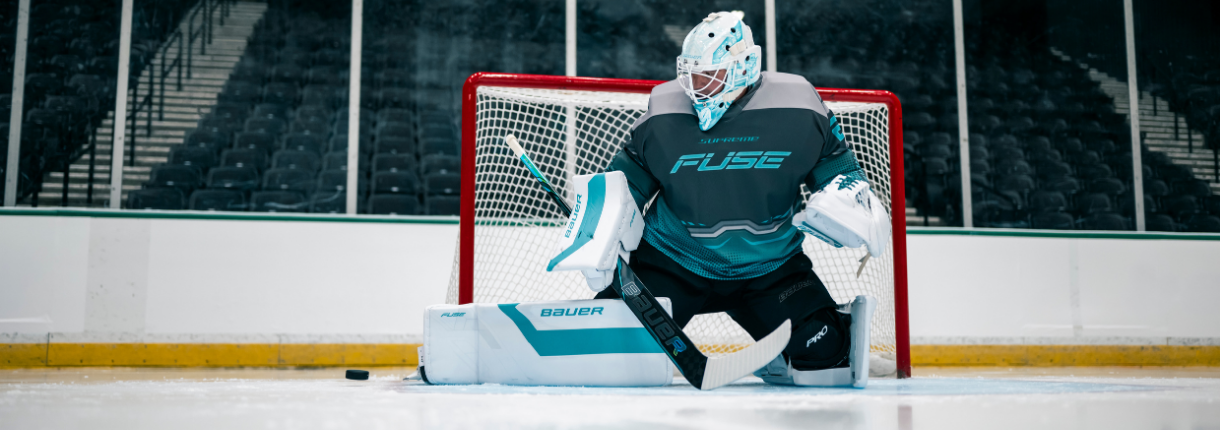
Choosing goalie pads is one of the most technical equipment decisions in all of hockey. The wrong size, the wrong flex, or the wrong pad style can fight your movement, slow your development, and leave you working against your gear instead of playing through it.
This is not about copying your favorite NHL goalie or buying the most expensive set on the shelf. The right goalie pads for your game come down to fit, sizing, playing style, flex, rebound behavior, and what level you actually play. Every one of those factors matters — and this guide covers all of them.
Quick Answer: How Do You Choose Goalie Pads?
Start with fit and knee placement. Your knee must land securely on the knee stack in the butterfly. Confirm the right size using your ATK or FTK measurement and the brand's current sizing chart. Then match the pad's flex, style, rebound response, slide surface, strapping, and protection level to your playing style, skill level, and budget.
The order to follow:
- Measure your ATK (ankle to knee) or FTK (floor to knee).
- Confirm your knee lands correctly on the knee stack in the butterfly.
- Choose the right category: youth, junior, intermediate, or senior.
- Match the pad to your skill level and how often you play.
- Decide between a stiffer butterfly-style pad, a softer hybrid feel, or a balanced build.
- Compare flex, rebound control, slide surface, weight, strapping, and toe ties.
- Evaluate pads with skates, pants, knee guards, and socks when possible.
- Ask for expert help if you're between sizes, switching brands, or buying for a growing goalie.
If You Are... Start By Prioritizing... A first-time goalie Fit, comfort, protection, and simple strapping A growing youth goalie Knee landing, mobility, and safe room to grow A butterfly goalie Structure, ice seal, slide speed, and rebound pop A hybrid or reactive goalie Boot flex, softer feel, control, and mobility A beer league goalie Comfort, protection, durability, and value A competitive goalie Precise fit, slide speed, rebound control, and durability An advanced goalie Custom options, exact flex, specific strapping, and pad feel
Fit First: The Most Important Rule of Goalie Pad Buying
Fit comes before brand, color, price, or pro influence. Every single time.
The most important thing is making sure your knee lands comfortably and centered on the knee stack — also known as the knee block — when you drop into the butterfly position. This ensures your knee stays protected while providing optimal balance, pad seal, and comfort, resulting in fewer pucks getting by.
A properly sized leg pad also allows the pads to cleanly rotate on your leg when making transitions from a game-ready stance to the butterfly and vice versa, ensuring smooth pad rotation so you're always ready to make the next save.
A pad that is too large may look like it covers more net, but it can make it harder to skate, recover, and rotate. A pad too big for the goalie can significantly inhibit movement and be a detriment to their performance in net. Likewise, choosing a pad too small will provide better mobility, but could leave areas of the leg exposed and will reduce the amount of net the goalie covers.
Fit First Rule: If your knee misses the knee stack in the butterfly, the pad is not the right fit — even if the color and brand look perfect.
Common fit red flags:
- Your knee lands above or below the knee stack
- Your knee slides off the landing block when you drop
- The pad does not rotate cleanly into the butterfly
- The thigh rises collide when you recover
- The boot feels like it binds your ankle
- The pads only feel stable when every strap is cranked tight
- A young goalie has so much room to grow that movement becomes awkward
How to Size Goalie Pads
Brands such as Bauer, Vaughn, and CCM may use slightly different measurement systems or fit styles, so understanding these components leads to smarter buying decisions. A size from one brand may not feel identical to the same listed size from another — which is why measurement comes before assumptions.
ATK and FTK: Your Two Key Measurements
Ankle to knee (ATK) measurement is the best way to find the base size of the pad and is generally considered the industry standard when sizing goalie pads.
ATK is simply a measurement from the center of the ankle bone to the middle of the knee cap. This can be done using a soft tape measure or by measuring first with a piece of string and then measuring the length of the string.
The majority of modern leg pads — CCM, Bauer, True, Warrior — use Floor-to-Knee (FTK) for leg pad sizing. FTK measures the distance from the floor to the center of your kneecap, and serves as the most reliable point when selecting pad size. Smaller brands reference ATK instead, which is the measurement from the middle ankle bone to the center of the kneecap. While these methods differ slightly, both FTK and ATK are designed to place your knee squarely in the knee block, but FTK is the industry standard and should be your first reference unless a brand specifically instructs otherwise.
How to take your ATK:
- Stand with your legs shoulder-width apart in a comfortable position
- Measure from the center of your ankle bone to the center of your kneecap
- Take the measurement on the outside of your leg
Quick ATK example: Multiply your ATK measurement by 2 to get your overall pad size. For example, an ATK of 17.5" suggests a 35" pad.
> Note on Bauer sizing: Bauer has gone away from traditional sizing and has introduced sizing with S, M, L, etc. Comparables to the traditional sizing are offered beside the Bauer size. Always check their current chart before ordering.
Base Size vs. Thigh Rise
Understanding the "+1" or "+2" on a pad size is critical. Thigh rise is the added height (measured in inches) at the top of a goalie pad. It allows a goalie to wear the correct size pad while adding height to the top of the pad to help cover more net and retain better coverage of the five-hole in the butterfly position. Thigh rise is identified with a "+" followed by a number in inches. For example, a 33+2" goalie pad would have a base height of 33" and an additional 2 inches added to the top of the pad.
Here's the part most buyers miss: A 33+2" pad and a 34+1" pad will be the same overall height top to bottom — however, the 33+2" pad will have its knee stack lower than the 34+1" pad.
That difference matters because your knee placement is determined by the base size, not total height.
More thigh rise is not always a benefit — it can cause the pad to be too tall and diminish your ability to be mobile. +1 thigh rise is typical, and it is uncommon to see a goalie wear any more than +2 thigh rise.
Confirming Fit: Wear the Full Setup
When trying on a pad to verify sizing, it is always recommended to try on the pad with the gear that interacts with the pad: skates, pants/breezers, and even socks/undergarments.
Goalie knee protectors can change how your knee sits in the cradle and how the pad rotates. Always test fit with the knee pads you plan on using.
Quick fit check steps:
- Stand in your natural goalie stance
- Drop into the butterfly
- Confirm your knee lands centered on the stack
- Check that the pad rotates cleanly
- Make sure the thigh rises do not collide
- Recover back to your stance and confirm the pad returns naturally
Choose the Right Pad Category: Youth, Junior, Intermediate, or Senior
Goalie pad categories are not just age labels. They differ in size range, pad width, protection level, construction quality, and intended level of play.
Youth Goalie Pads
Some differences should be noted in junior and youth pads. Youth pads generally feature a very basic design construction to help facilitate ease of learning the position and getting dressed before the game. For first-time goalies, this simplicity is an advantage — the goal is learning the position, not fighting complex gear.
Junior Goalie Pads
Moving into junior pads, this classification will benefit from additional protection and padding areas to help protect against shots as opponents become more skilled. Junior pads are a meaningful step up in durability as shots get harder.
Intermediate Goalie Pads
Available in two levels of protection, intermediate pads bridge the gap between junior and senior. They're sized proportionally to older goalies aged roughly 11–15 who are growing into adult dimensions.
Senior Goalie Pads
Senior pads offer the widest range in protection, quality, and price — available for goalies aged 13 and up, including adults. Senior pads are typically 11 inches wide, which is the legal maximum. They come in a wide variety of colors, and custom modifications are generally reserved for pro-level units.
A critical note for parents of growing goalies: While instinct may be to choose a size that gives them room to grow into, in reality too big of a pad can inhibit their skill development and create bad habits. It is critical that when sizing a pad for a growing goalie, when in the butterfly position, the knee lands on the knee stack. The goal is to have the knee land in the lower half (without sliding off), so the goalie still has room to grow. Once the goalie's knee reaches the top of the knee stack in the butterfly, it will be time to move on to the next size.
Choose by Skill Level and Usage
How often and how competitively you play should drive your buying decision just as much as size.
| Goalie Type | Best Pad Priorities | Avoid |
|---|---|---|
| First-time youth goalie | Fit, protection, mobility, and easy strapping | Oversizing for growth |
| Developing travel goalie | Knee landing, durability, support, and comfort | Buying only by color or brand |
| Adult recreational goalie | Comfort, protection, value, and simple setup | Paying for features you won't use |
| Competitive goalie | Slide speed, rebound control, precise fit, and durability | Ignoring strapping and toe setup |
| Advanced/elite goalie | Custom options, exact flex profile, and elite materials | Choosing without knowing your preferences |
First-Time Goalies
Entry-level pads are best for brand-new goalies and parents buying starter gear. These pads prioritize comfort, flexibility, and simple setup at affordable prices. They offer a softer, more forgiving feel that's easy to move in while you build skating and butterfly habits.
Competitive Goalies
More experienced goalies may prefer pro-style pads with stiffer construction, more precise strapping systems, and integrated sliders. At higher levels, small differences in rotation, rebound response, and strapping setup become very noticeable.
Advanced Goalies
Elite players often consider custom goalie equipment to fine-tune every element to their technique and stance. Custom is most useful when you already know exactly what problem you're trying to solve.
Match the Pads to Your Playing Style
Modern pads are often labeled "butterfly" or "hybrid," but the real distinction is in how the pad behaves. Think about how you actually move in the crease — not how you think you should.
Butterfly or Structured Goalies
Traditionally, a stiffer pad is ideal for sliding and feeling solid in the butterfly, whereas a more flexible pad is designed to stay more in tune with a goalie's movements. Stiff leg pads, sometimes called butterfly style goalie pads, are designed to keep their rigid shape and provide a solid base for landing in the butterfly. These pads tend to fit looser to provide ample rotation when dropping down.
Prioritize:
- Stiffer core for consistent blocking surface
- Strong ice seal for clean butterfly coverage
- Fast sliding inner edge
- Predictable rebound response
- Structured thigh rise
Hybrid or Reactive Goalies
A more athletic and reactionary goalie would likely need a soft pad that offers more mobility and flexibility to move quickly around the crease.
Hybrid pads are geared toward goalies who prioritize mobility and reflex saves in the crease while maintaining strong butterfly performance. They usually feature more flex through the pad and are designed to keep the pad feeling "connected" during movement — great for goalies who mix butterfly with active skating and reactive saves.
Prioritize:
- Softer boot and knee flex
- More connected pad feel
- Easier lateral recovery
- Controlled, softer rebound response
- Flexible movement through multiple positions
Balanced Modern Goalies
Many goalies don't fit cleanly into one category. A balanced pad offers moderate flex, good seal, smooth sliding, and manageable rebound response — strong structure without feeling locked in. This is often the smart starting point for goalies still developing their style.
Understand Goalie Pad Flex
The flex profile on a goalie leg pad determines how much the pad can bend and is often associated with mobility. But flex isn't just one thing—it affects different parts of the pad in different ways.
| Flex Zone | What It Affects | More Structure Helps If... | More Flex Helps If... |
|---|---|---|---|
| Boot | Ankle freedom and skate connection | You want a locked-in, stable base | You want ankle freedom and easier recovery |
| Knee | Landing feel and pad bend | You want a firm butterfly landing | You move and recover frequently |
| Thigh Rise | Five-hole seal and pad overlap | You want more coverage and structure | You want less pad interference |
| Core | Rebound response and long-term shape | You want hard, predictable rebounds | You want softer, more forgiving control |
Boot Flex
A softer boot allows more ankle freedom and may feel more natural during recoveries and push-outs. A stiffer boot can feel more stable and planted, which is useful for goalies who rely on strong lateral pushes.
Knee Flex
The knee flex zone affects how the pad bends when you drop. Stiffer construction creates a firmer, more structured butterfly landing, while additional flex makes movement and recovery feel easier during varied save selections.
Core Stiffness
The core affects the pad's overall shape, long-term structure, and rebound characteristics. Stiffer cores produce harder, more predictable rebounds, while softer cores absorb more energy and can keep rebounds closer to the crease.
Pad Face, Rebound Control, and Knee Rolls
Flat-Faced Pads
Butterfly pads are the most common style, and are the standard for goalies who rely on positioning and controlled rebounds. They use a flatter face and a stiffer core to redirect pucks away from the crease while helping maximize lower-net coverage and five-hole seal.
Knee-Roll Pads
Knee-roll pads have horizontal rolls across the pad face. They're associated with a softer, more flexible feel and a traditional look. The Vaughn Velocity VX1 Pro Carbon leg pads are a strong example of this style, combining traditional knee rolls with modern performance. They give goaltenders the freedom to butterfly or pad stack whenever the moment calls for it, all while maintaining a classic look and responsive feel.
Hard Rebounds vs. Softer Control
The right rebound style depends entirely on how you manage second chances. Ask yourself:
- Do I want pucks to kick away hard to the corners?
- Do I prefer to deaden pucks and smother them?
- Can I direct hard rebounds into safe areas?
- Does my level of play punish loose pucks near the crease quickly?
Hard rebounds can clear danger zones — but only if you can consistently direct them. Softer rebounds keep pucks closer, which is useful if your team or positioning isn't ready to handle live pucks in traffic.
Slide Surface, Weight, and Balance
Slide Surface and Inner Edge
Sliding ability is a critical component of the overall performance of your goalie pads. The inner edge material determines how the pad interacts with the ice during butterfly slides and lateral movement.
Each major brand has developed its own approach: CCM's SpeedSkin is designed to create a nearly frictionless surface that assists goalies in moving across the ice; it has been included in stock designs on all of their pads since launch and is available across all models. Brian's and Vaughn each use a similar slide skin, which boasts a waxy feel to create a smooth slide across the ice. These slide surfaces are made to be durable without lowering performance, regardless of ice conditions.
Weight and Balance
Weight can be an important factor in your decision when buying leg pads, however it shouldn't be the only factor. The way a pad is balanced, distributes weight, and the amount of friction on the ice will all influence how heavy the pads feel, regardless of their actual weight.
A lightweight pad that doesn't fit correctly will still feel awkward. A slightly heavier pad that rotates cleanly and balances well may actually feel faster on the ice.
Strapping, Toe Ties, and Leg Channel
Strapping and toe setup can completely change how a pad feels. This is one of the most overlooked parts of the buying decision.
Why Strapping Matters
Strapping affects how connected the pad feels to your leg, and how cleanly it rotates. Too tight, and the pad fights your butterfly drop. Too loose, and it can feel unstable or sloppy.
Key strapping considerations:
- Knee strap position and tension
- Calf strap use and tightness
- Boot strap use (many modern goalies remove it entirely)
- Whether the pad returns naturally after rotating
- Whether you need to overtighten anything to feel comfortable
If the pad only feels right when every strap is cranked down hard, that's a red flag — it likely signals a fit or style mismatch, not just a strapping preference.
Toe Ties
How you connect the boot of the pad to your skate has a meaningful impact on feel and movement. Elastic toe ties have come onto the scene in a big way. Elastic toe ties satisfy both responsiveness and minimal tension on the ankle and pad. Traditional lace ties feel more connected but offer less stretch. Most major brands now include elastic or hybrid toe setups as their standard, though setups can be swapped out to match your preference.
Leg Channel
The leg channel adjustment allows goalies to choose between tight or loose fits, which impacts pad rotation and mobility. A tighter leg channel gives a more connected feel; a looser channel allows the pad to rotate more freely. Goalies who rely on quick pad rotation often prefer a slightly looser channel, while goalies who want the pad to move closely with the leg prefer a tighter setup.
Knee Block, Knee Cradle, and Knee Guards
The knee area is the foundation of pad fit. If it doesn't work here, nothing else about the pad will feel right.
The knee block (or knee stack) is the landing area your knee hits in the butterfly. It should feel stable and absorb impact cleanly. If pads are not properly sized, the knee could miss the landing pad and make contact with the ice. Due to the fact that goalies drop to their knees often, improperly sized pads can lead to injury.
The knee cradle controls how locked-in your knee feels inside the pad. Some goalies prefer a secure, snug cradle. Others like more freedom so the pad can rotate easily without interference.
Don't forget knee guards: Goalie knee protectors can change how your knee sits in the cradle and how the pad rotates. Always test fit with the knee pads you plan on using.
Entry-Level vs. Mid-Range vs. Pro Goalie Pads
Entry-Level Pads (~$100–$400)
Best for beginners, recreational goalies, fast-growing youth players, and budget-conscious buyers. These pads prioritize comfort, flexibility, and simple setup at affordable prices. The goal is reliable protection and proper fit — not advanced features that won't be used.
Bauer GSX Senior Goalie Leg Pads
$599.99
CCM EFlex 7.5 Senior Goalie Leg Pads
$599.99
Mid-Range Pads (~$400–$1,000)
Best for travel players, competitive youth goalies, and adult league goalies who play regularly. This is the best all-around option for most goalies who play regularly — this is where you'll find the best value: lighter builds, better rotation, and a stronger seal.
CCM Tacks Senior Goalie Leg Pads
$999.99
Vaughn ION Pro Senior Goalie Leg Pads
$1,049.99
Pro-Level Pads (~$1,000–$2,000+)
Best for advanced goalies, high-frequency players, and competitive goalies who need maximum durability and performance. Built for goalies who want pro-level performance: maximum pad seal, predictable rebounds, and the lightest, most responsive construction. These pads are stiff and connected, sealing the ice quickly and staying stable in the butterfly and during recoveries, with premium materials, top-end sliding surfaces, advanced strapping, and the most consistent performance under heavy shot volume.
Brian's OPTiK 4 Senior Goalie Leg Pads
$1,999.99
TRUE Catalyst Nitro Senior Goalie Leg Pads
$1,899.99
Bauer Supreme FUSE Senior Goalie Leg Pads
$1,899.99
CCM Tacks Pro Senior Goalie Leg Pads
$1,999.99
Stock vs. Custom Goalie Pads
Stock Pads Are the Right Call When:
- You need pads sooner rather than later
- You're still learning your preferences
- You fit well into standard sizing
- You want a simpler buying process
- You're shopping within a defined budget
Custom Pads Make Sense When:
- You know exactly what fit and flex you want
- You need a specific strapping or thigh rise setup
- You have strong preferences based on your last set
- You want custom colors or a personalized build
- You play often enough to justify the investment and wait time
Elite players often consider custom goalie equipment to fine-tune every element to their technique and stance. But custom should solve a real, known problem — not be a shortcut around proper sizing and style selection. First-time buyers and parents buying for new goalies are almost always better off starting with stock pads and expert sizing help.
League Rules and Safety Note
Competitive goalies need to know the rules before buying pads that push size limits. The leg guards worn by goalkeepers in USA Hockey shall not exceed 11 inches in extreme width and 38 inches in length. The boot channel of the goalkeeper pad must be flat or concave in appearance with no additional attachments such as a puck foil.
Calf protectors must follow the contour of the calf and ankle and can have a thickness of no greater than 1½ inches. The knee strap pad is not to exceed 1½ inches in thickness and must be fastened to the inner risers and follow the contour of the inner knee. All thigh pads must follow the contour of the leg, or be placed under the pant, and the maximum width of the thigh pad across the front of the leg is 10 inches.
If you play in an organized league, always check the current equipment rules for your governing body before choosing pads that push size limits or include modifications. When in doubt, prioritize fit, protection, and legal playability over extra surface area.
Common Goalie Pad Buying Mistakes
1. Buying Pads Too Big for Extra Coverage
Bigger pads do not automatically mean better coverage. If they prevent your knee from landing correctly or slow your movement, they're hurting — not helping.
2. Choosing Pads Only Because a Pro Wears the Brand
It's great to be inspired by elite goalies, but your body, level, stance, and movement matter more than a pro's brand choice. Finding the right goalie pads isn't just about price or brand — it's about matching your pads to your style, your body, and your game.
3. Ignoring Knee Placement
This is the foundation of pad fit. The most important issue when sizing leg pads is making sure the goaltender's knee is in the cradle. Everything else follows from there.
4. Adding Thigh Rise to Fix the Wrong Base Size
Thigh rise adds coverage above the knee — it does not fix a base size that doesn't fit. Get the base size right first.
5. Not Trying Pads With the Full Setup
When trying on a pad to verify sizing, it is always recommended to try on the pad with the gear that interacts with the pad: skates, pants/breezers, and even socks/undergarments.
6. Overtightening Straps to Compensate for Poor Fit
If you need every strap cranked to feel secure, there is a fit or style problem — not just a strap tension preference.
7. Picking the Stiffest Pad Without Considering Mobility
Structure and rebound pop are great — but not for every goalie. Stiffer pads generally provide better seal and structure but require more effort to recover. Softer, more flexible pads make movement easier but may sacrifice some seal.
8. Choosing by Height Alone
While height can be factored into some sizing charts, it's best to use your FTK or ATK measurements for the best accuracy. Two goalies of the same height can have different leg proportions.
9. Forgetting League Rules
Competitive goalies should verify equipment regulations for their league or governing body before purchasing oversized or modified pads.
10. Buying Pro-Level Pads Before Knowing What Features Matter
Premium pads are worth it when they match your real preferences. They are not a shortcut around proper sizing, playing style selection, or knowing what you actually need.
Goalie Pad Comparison: Top Pads by Style and Level
| Pad | Style | Flex Profile | Rebound | Slide Technology | Best For | Price Tier |
|---|---|---|---|---|---|---|
| CCM EFlex 7 Pro | Hybrid | Soft–Medium | Controlled | Cross Glide | Mobile, reactive goalies | Premium |
| CCM Tacks Pro | Butterfly | Stiff | Explosive | SpeedSkin | Power butterfly goalies seeking maximum seal and active rebounds | Premium |
| Brian's OPTiK 4 | Butterfly | Very Stiff | Elite | Primo Slide | Aggressive butterfly goalies prioritizing powerful rebounds | Premium |
| Bauer Vapor FlyLite | Hybrid | Medium | Explosive | SL1D3R | Fast, athletic goalies who rely on mobility | Premium |
| Bauer Supreme Fuse | Butterfly | Mid–Stiff | Explosive | SL1D3R | Butterfly goalies wanting structure, stability, and strong rebound control | Premium |
| Vaughn Velocity VX1 Pro Carbon | Hybrid | Mid–Stiff | Controlled | QuickSlide | Goalies wanting a traditional feel with modern performance | Premium |
| True Catalyst Nitro | Hybrid / Butterfly | Stiff | Strong | Diamond Glide | Elite goalies wanting butterfly performance with added mobility | Premium |
| Warrior Ritual G7 RTL | Butterfly | Medium | Controlled | SlidePlate | Competitive goalies wanting excellent adjustability and value | Mid-Range |
| Brian's ICONIK 2 | Hybrid | Medium | Controlled | Primo Slide | Goalies seeking lightweight mobility with customizable flex | Premium |
| Bauer GSX | Balanced | Soft | Basic | Standard | New goalies and recreational players | Entry |
Final Goalie Pad Buying Checklist
Before pulling the trigger on any set of goalie pads, run through this list:
- My knee lands correctly in the butterfly on the knee stack
- I checked the brand's current sizing chart (not just general sizing)
- I understand my base size and my thigh rise preference
- I evaluated the pads with skates, knee guards, pants, and socks
- The pads rotate cleanly into the butterfly
- The thigh rises don't collide or interfere during recovery
- The boot doesn't bind my ankle
- The strapping feels secure without being overtightened
- The flex profile matches my playing style
- The rebound behavior matches how I manage second chances
- The slide surface fits how much I rely on lateral movement
- The pad level matches how often and how competitively I play
- I know whether stock or custom makes sense for me right now
- I know when to ask for expert help
FAQ: How to Choose Goalie Pads
How should goalie pads fit?
Your knee should land comfortably and centered on the knee stack (knee block) when you drop into the butterfly position. This ensures your knee stays protected while providing optimal balance, pad seal, and comfort. A properly sized leg pad also allows the pads to cleanly rotate when transitioning from your stance to the butterfly and back.
What is ATK and how do I measure it for goalie pads?
Ankle to Knee (ATK) is the most common measurement in finding the correct pad size. It is simply a measurement from the center of the ankle bone to the middle of the knee cap. Stand comfortably, take the measurement on the outside of your leg, then compare it to the specific brand's sizing chart.
What does the +1 or +2 mean on goalie pads?
The "+" number on goalie leg pads indicates the added length in inches to the thigh rise for added five-hole coverage when you drop into the butterfly. The most common options are +1" and +2", which help goalies fine-tune coverage and mobility based on playing style. Thigh rise is a personal preference and should help you seal the five-hole without forcing the pads to overlap excessively or put strain on your hips.
Should I buy goalie pads a size up so my kid can grow into them?
Too big of a pad can inhibit skill development and create bad habits. It is critical that when sizing a pad for a growing goalie, when in the butterfly position, the knee lands on the knee stack. The goal is to have the knee land in the lower half (without sliding off), giving the goalie room to grow. Once the goalie's knee reaches the top of the knee stack in butterfly position, it will be time to move on to the next size pad.
What is the difference between butterfly and hybrid goalie pads?
Butterfly pads are built for goalies who rely on structured positioning, hard drops, and active rebounds. If you play a position-first, blocking style game and want strong, active rebounds, go butterfly. If you want more flex, softer rebounds, and better pad mobility, go hybrid.
How tight should goalie pad straps be?
Straps should be secure without being restrictive. You want the leg pads to rotate freely into the butterfly while staying stable when you move. If you're cranking straps to compensate for poor fit, that's a fit problem — not a strap problem.
Do I need to size goalie pads by height?
While height can be factored into some sizing charts, it's best to use your FTK or ATK measurements for the best accuracy. Two goalies of the same height can have different leg proportions. Always use your leg measurements as the primary sizing reference, not height alone.
How wide can goalie pads legally be in USA Hockey?
The leg guards worn by goalkeepers shall not exceed 11 inches in extreme width and 38 inches in length. Always check your specific league's equipment rules before buying.
Find the Right Goalie Pads at GoalieMonkey
The right goalie pads are not the biggest, the stiffest, the most expensive, or the ones your favorite pro wears. The best pads are the ones that fit correctly, let your knee land securely, rotate naturally, support your playing style, and match the level of hockey you actually play.
Start with fit. Confirm your size. Think about how you move. Then compare flex, rebound control, slide surface, strapping, toe ties, and price tier.
When you're ready, explore GoalieMonkey's full selection of goalie leg pads, check out the Goalie Leg Pad Sizing Chart, browse the Best Goalie Leg Pads for 2026, or contact the GoalieMonkey sales team for personalized sizing help. We play the position — we know what works.